Sunday, January 15, 2017

Fandom and Identification

During the NFL playoffs, Diane and I wear our Packer T-shirts on gameday (like today!  #GoPack).

We identify ourselves as followers of that specific pro football team. I also have Packer gear in my office, stickers on my car, autographed items by Packer players and ... wait for it ... season tickets to all their home games at Lambeau Field.  Not to mention that in my chest freezer I have two boxes of genuine sod from Lambeau - real Frozen Tundra!  Man, I identify with that team.

What it made me wonder about is how do I identify myself as a follower of Jesus? The Scriptures teach that identification with Christ is an essential element of a faith that leads to salvation.  Theologians like N.T. Wright have devoted entire books to the concept of a believer's identity being tied up with Jesus Christ, it is that important that we do so.  

So, what evidence is there that I identify with Jesus and depend on Him for salvation?  I certainly have the gear (Bibles, study materials, t-shirts, and mugs) at home, in my office, in my car... never did get Jesus' autograph (or a piece of the True Cross), but nevertheless, there is evidence.  There's even ... wait for it ... a Masters' Degree in Theology from Bethel Seminary.  I suppose I could go up there and cut some sod from the campus lawn and put it in my freezer as further proof...

Beyond the gear, I do also sprinkle my emails and conversation at work occasionally with tangential references to Scripture and the stories Jesus told.  I've preached sermons, sang inspirational songs in worship, led Bible studies, helped to grow up new believers into a more mature faith, given funds to people and organizations that advance the Kingdom of God, etc.

Still, I hear in the back of my mind the Apostle Paul saying to the Corinthian church:

"If I speak in the tongues of men and of angels, but have not love, I am a noisy gong or a clanging cymbal. And if I have prophetic powers, and understand all mysteries and all knowledge, and if I have all faith, so as to remove mountains, but have not love, I am nothing.  If I give away all I have, and if I deliver my body to be burned, but have not love, I gain nothing."

This reminds me that the gear means nothing, the acts of devotion mean nothing.  What is telling is my heart attitude, which no one really sees.  The outward appearance of fandom can easily mislead others; we can even deceive ourselves into thinking we identify with the object of our devotion because of all the things we do.  As God said to Samuel when he was looking for a replacement for King Saul, "the Lord sees not as man sees; man looks on the outward appearance, but the Lord looks on the heart.”  May my heart be true, though all else be outward show.


Genetics and the Doctrine of Original Sin

With the proliferation of DNA testing into criminal justice, paternity and prenatal testing, and ancestry research, it was only a matter of time before knowing what's in your genome became affordable and within the reach of "regular people" (like me).

About a year ago, I sent in my saliva sample and $99 and got back a .csv file full of crazy stuff, like this:

#Genetic data is provided below as five TAB delimited columns.  Each line 
#corresponds to a SNP.  Column one provides the SNP identifier (rsID where 
#possible).  Columns two and three contain the chromosome and basepair position 
#of the SNP using human reference build 37.1 coordinates.  Columns four and five 
#contain the two alleles observed at this SNP (genotype).  The genotype is reported 
#on the forward (+) strand with respect to the human reference.
rsid chromosome position allele1 allele2
rs4477212 1 82154 T T
rs3131972 1 752721 G G
rs12562034 1 768448 G G
rs11240777 1 798959 G G
rs6681049 1 800007 C C 

Page after page of this stuff is what was used to determine that I am less Western European (particularly Saxon and Bavarian) in ancestry than I had thought.  Instead I have more of an Eastern European ancestry (think Prussian and Austro-Hungarian empires), with a chunk of British and Scandinavian heritage mixed in.  Okay, then.  So much for my parents' and grandparents' stories..

That process was pretty interesting.  But even moreso was what happened when I joined Livewello.com and sent my genomic record in to look for mutations (favorable and unfavorable) that might be useful to know about, like for instance knowing that I have a genetic predisposition to reject the effects of Metformin (a common pre-diabetic medicine) because I have a gene mutation that blocks its absorption into the bloodstream.  But on the other hand, I have genetics that help me to resist substance addictions, and lack mutations which would tend toward Alzheimer's and Dementia.  Woo!  I'll be the life of the party in the nursing home!

I told my local endocrine specialist about the anti-metformin gene and she just shrugged and said "nothing I know anything about", and went right on with her normal treatments.  But then, why should she be expected to know about this emerging field, when it's not what she was trained in?

So, over Christmas, Diane and I drove to Austin, TX to see our daughter.  While there, I visited a clinic which specializes in genetic disorders (especially of metabolism) to see what they could tell me.  Yikes!  I feel like the Apostle Paul when he said "Oh wretched man that I am!  Who will deliver me from this body of death?" Page after page of bad news.

Well, not THAT bad.  It's just that in dealing with inflammation of all sorts, processing key nutrients, weight management, and production of energy, I have genetic deficiencies that spell an uphill battle to ever be "normal" in those areas.  I've known for years that I have tendencies toward certain health problems, like my parents and siblings did, but never anything that conclusively points to why.  Now I know - a lot of it is genetics.

And yet, even though genetics determine your strengths and weaknesses, they don't doom you to a particular lifestyle.  There are things you can do to delay onset of conditions, to supplement chemically what your body doesn't do well, etc.  You still have control over how you deal with genetic predispositions, even though they make make it hard to be in perfect health.

Here is an excerpt from the geneticist's report explaining a little of the interpretation of gene mutations:


So, today I got to thinking about the doctrine of Original Sin in light of all this recent discovery of inherited gene mutations, and I came to the conclusion that Original Sin is like having a metaphysical genetic mutation (as opposed to a physical one) which gives a you genetic predisposition toward estrangement toward (or rebellion against) God.  All of humanity is at least heterozygous (+/-) for this Sin gene; we all have a difficult time being obedient to God, or even just to our own conscience (a proxy for God in those who don't know God).  Some of humanity, I think, are homozygous (+/+) for the Sin gene and by nature have a much more difficult time refraining from doing what is morally wrong.

But, having the genetic predisposition doesn't mean we are helpless and doomed to an immoral life estranged from God.  There are things we can do to ward off temptation, to supplement with prayer and reading in the areas where we don't handle things well, to reach out to God for help fighting against this genetic defect passed down from Eve to us (like mitochondrial DNA).

Fortunately, there was One who was born without that Sin mutation (-/-) and who stands in our place today, offering to us a metaphysical version of "gene splicing" to remove our unfavorable mutation.  His operating room is in the Hereafter, but eventually we who believe will be cured and live a life in Eternity free of the struggle against Sin.  Thanks be to God!


Monday, December 19, 2016

Humanity's Tripartite Nature

We are made up of Body, Soul, and Spirit.

Body is made up of Blood, Bone, and Tissue.

Soul is made up of Emotions, Will and Reason.

Spirit is made up of...

of...

hm.

Well, 2 out of 3 ain't bad.

Sunday, December 4, 2016

Retirement as a Career

Anticipating retirement in 4-5 years, I've already laid out a rough schedule for my days:

     9:00 AM      Rise & ready self for day (coffee, groom, dress)
   10:30 AM      Body Work (mall walking, stationary bike, weights, on a rotation)
   12:00 PM       Lunch on own
     1:00 PM       Mental Stimulation (Reading, brain games, statistics)
     2:00 PM       Emotional Work (Music, Art, Poetry, etc. - appreciating or creating)
     3:00 PM       Soul Stimulation (Bible Study, Devotional Writing, Blogging)
     4:00 PM       Slack time if any of the above run over
     5:00 PM       Dinner with spouse (prep and consumption)
     7:00 PM       Relationship Work (time with spouse and/or friends)
   10:00 PM       Frivolous Indulgences
   12:00 PM       Sleep

I fully expect to keep a spreadsheet on the above.  :)

*******

A couple of days ago, I ran across a post from a website called Quiet Revolution (it's mostly about introverts - go figure).  It warned about the artificiality of retirement and encouraged the benefits of lifelong work.  I've certainly heard that advice before, but it's the first time that I've thought about the idea of retirement as a 20+ year career that I will be devoting myself to soon.  Not a bad way of seeing it, really - as a job to do, and to do well.  It made me think that I should write up a job description for retirement, set annual goals and interim milestones, track my performance, etc.  Hm.

So here's the article - which may form a very useful guide to my next career.

Keep working.  
And make sure whatever you’re doing includes the 4 S’s of meaningful work:

S – Social

We are the most social mammals on the planet for a reason, and it’s not just the extroverts who can master this. Look, according to Stumbling on Happiness by Harvard psychologist Daniel Gilbert, our social relationships have a greater effect on our happiness than our income, religion, gender, or even health. What does a good workplace foster? Small team dinners. CEO AMAs. Lunch walking groups. Work sports leagues. If these are missing, start one. 

S – Structure

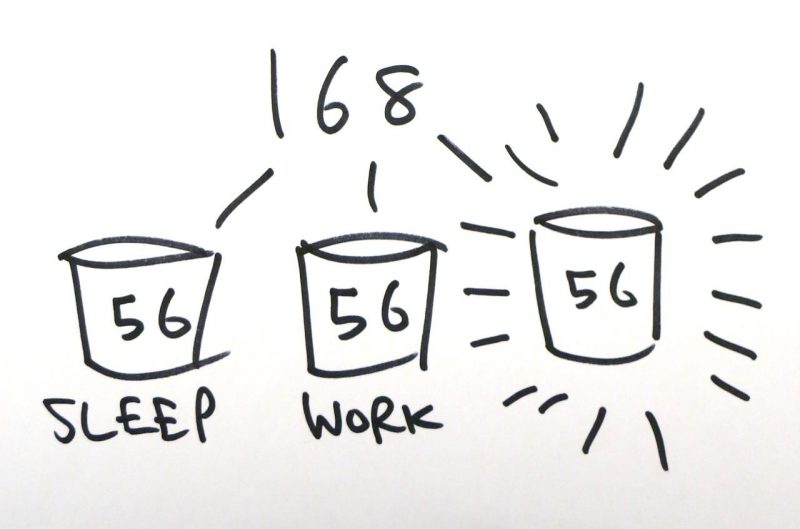
There are 168 hours in a week. Fifty-six are for sleep (eight hours a night if you can get it), 56 for work (including things like commuting and extra work at home), and 56 for your passion.
three 56-hour buckets
On structure, there are two things to point out. One, work helps create and pay for your third bucket—the fun bucket, the passion bucket. And two, if everyone in this structure has a third bucket, what can each person bring in from outside of work? Can the word nerd start a book club? Can the hospital volunteer start a company volunteer program? Can the late night DJ plan the Christmas party? 
Work structure should allow outside work passions to be big parts of our lives. 

S – Stimulation

Always be on the lookout to learn something new. In every job you have, ensure the steepest possible learning curves are between “value giving” and “value getting.” Examples to make sure this happens are things such as staying a maximum of two years in roles, initiating job sharing or job trades, planning regular development sessions, and scheduling quarterly growth meetings with one- and two-up managers. Make sure you can always say yes to the question “Am I learning a lot and adding a lot?” If your answer is tilted one way, it means you’re giving something else up. 

S – Story

There’s a reason why Medtronic, the medical devices company famous for popularizing the pacemaker, has family members of patients read letters at company meetings. How would you feel about your job if an 11-year-old girl thanked you for giving her five extra years of memories with her father?  
“Story” is all about feeling that you’re part of something bigger than yourself. It’s about first ensuring the company’s mission and higher-level purpose capture the heart and then bringing the mission to life by regularly sharing customer stories, hanging anecdotal posters on walls, and talking about it at open or closed meetings. 
At Facebook, you’re connecting the world. At Wikipedia, you’re giving the world the sum of human knowledge free. At your local paper, you’re increasing community. 
What’s your workplace story?
So, I say never give up work. Meaningful work. Work you love. Because you’ll be giving up the 4 S’s—Social, Structure, Stimulation, and Story—you get every day from being there. 

Saturday, November 12, 2016

Power To The People! (but which people?)

Dear reader, as I have said before, I did not vote for Donald Trump, nor did I ever support him.  But after Trump's victory this week, which nearly every pollster, politico and pundit considered virtually impossible, and ludicrous to contemplate, I grew philosophical about the nature of populism and elitism.

Wikipedia describes Populism as: a political ideology that holds that virtuous citizens are mistreated by a small circle of elites, who can be overthrown if the people recognize the danger and work together. Populism depicts elites as trampling on the rights, values, and voice of the legitimate people.

Um, yeah.  That feels about right.  From time to time, when governments become hidebound and bureaucratic, run by a relatively small circle of elites (whether political, intellectual, economic, or media types), the rest of society begins to feel left out, ignored, disenfranchised, marginalized or whatever other descriptor you care to use.  At some point, a collective sentiment begins to form and this forgotten segment of society wants to throw off the yoke of the elites and take back power.

Populism can come from the right or the left of the political spectrum, and this year we had both represented in the form of Donald Trump and Bernie Sanders.  To me, that would have been the more interesting contest.  Instead the left-leaning populists who followed Bernie didn't turn out for the candidate of the establishment elites:  Hillary Clinton.  And when she referred to Trump supporters as   a "basket of deplorables", I think for many that was the epitome of elitism, and it's the point at which her fortunes began to fall.

Wikipedia refers to Elitism like this: Elitism is the belief or attitude that some individuals who form an elite—a select group of people with a certain ancestry, intrinsic quality or worth, high intellect, wealth, specialized training or experience, or other distinctive attributes—are those whose influence or authority is greater than that of others; whose views on a matter are to be taken more seriously or carry more weight; whose views or actions are more likely to be constructive to society as a whole; or whose extraordinary skills, abilities, or wisdom render them especially fit to govern.

Yup.  Right again.  The characteristic most central to members of the elite is that they honestly believe they know what is best for the rest of the people - that the rabble are ignorant and can't possibly direct their own affairs, much less society's, with anywhere near the efficiency and benificence that the elites can.  That was Hillary in a nutshell; Hillary knows best.  So do others of her class.  The rabble knows nothing and must be properly guided for their own good.

Oops!  The rabble rose up and threw out the elites this week.  Poor, ungrateful ignorant wretches, these deplorables.  Who do they think they are, the backward Colonials who threw off the rule of King George?  The French peasants who repudiated the rule of Marie Antoinette and the ruling classes in Europe?  Electing Donald Trump is simply proof to elitists that when left to their own devices the rabble make incredibly poor choices.  Well, elites, just keep telling yourself that.  Sit on the sidelines and criticize, while the rabble consolidates power.  You're on the outside looking in now.


Monday, October 10, 2016

Desire vs Reason

I was thinking Sunday about how reason should inform us of what is true and what is right and what is good.  This is particularly so if our reason is informed by our conscience, and our conscience by our faith and the Scriptures.

For those not so informed, however, reason devolves into what is naturally a value system derived from what we think is true, right and good, APART from such sources as faith and the Scriptures.  More on this in a minute.

We are often presented today with the supposed truism that if we are more educated, we have more facts to reason with and thus will make better decisions and more "moral" choices.  This supposes the supremacy of reason over other motivations (like emotion and desire).  But even the great proponents of rationalism were also driven by desire.

Desire and reason often work at cross purposes with each other.  Not that desire is bad (although the Stoics thought so) in and of itself, it's simple different.  Each are strong motivators.  Those who argue for the supremacy of reason also believe that as education increases, the power of reason increases and so education leads to the triumph of reason.

Balderdash!  I say.  Poppycock!  Horse hockey, even!  Desire is every bit as strong a motivator as reason and often wins out over it.  The head and the heart can be adversaries... but they don't have to be.  Many desires are reasonable ones:

We desire to be: Loved.  Accepted.  Successful.  Comforted.  Thought (and spoken) well of.  Protected.  Understood.

There's nothing wrong with these things.  They are natural and reasonable desires.  It's when they get out of control that we are seen to "behave irrationally", when our desire to be successful leads to overwork, when our desire to be loved leads to promiscuity, when our desire for protection leads to paranoia.

So, wouldn't it be a good thing to see what we know is true and right and good, and find our where our desires line up with our reason?  When reason and desire can partner up, then motivation can be wholistic and more powerful than if reason and desire oppose each other.

There are times when you can't explain why you want something, you can't explain desire.  From this flows the old saying "the heart has reasons that reason doesn't know."  But if you can think through your desires and discover whether they align well with what you know, then perhaps you will be unified and live a life of well-being.  And that well-being, that "Shalom", will be ever more such if our reason is informed by the Creator and the Author of our faith, who said: "My peace (shalom) I leave with you."

Perhaps I will live a life of well-being, of Shalom, too, if I heed my own advice.


Wednesday, October 5, 2016

Life in Thirds

In the shower the other day (where almost all big ideas happen - don't ask me why), I thought about human life (at least in the West) in 3 segments.  Maybe it was the occasion of my wife turning 60 this year and my son turning 30 next year.  Whatever the reason I puzzled over what the main purpose was of these 30-year cohorts of time, assuming one lives until 90.

The first 30 years seem to be best described as a period of FORMATION.  You are learning, growing, forming personality and character, settling on a career direction, choosing values and beliefs.  You are becoming who you will be as an adult.

The next 30 years seem to be best described as a period of GENERATION.  Between 30 and 60 most people are out there doing and being what they were formed into in their first 30 years.  They are producing, creating, earning, interacting with others, building relationships, having babies in some cases, and so on.  They are using what they were formed to be in order to generate spouses, heirs, friendships, wealth, service, etc.

Well, if these are true, what then are the last 30 years to be, the years from 60 to 90 (or death, if it comes sooner)?  That, maybe, was the real question I was noodling over.  What should this last third of my life be about?  The conclusion I came to was this:

The last 30 years seem to be best described as a period of DISTRIBUTION.  After age 60 you begin to distribute what you have learned and produced to others who will succeed you, who will come up behind you.  You dispense wisdom you've accumulated, you offer advice based on years of life experience, you arrange to leave your assets to your heirs, you define what your legacy will be, what people will remember you for (at least for 4 generations; see this post for details).

This thought process was helpful, I think.  It reminds me that I have really passed the age of accumulation, and I need to think about what I will be leaving behind.  I suppose it's called "getting your house in order"; but it's also called "leaving a legacy".  I was formed into who I am today a long time ago.  I have only a few years left to generate wealth or accumulate useful life experience.  Soon I will be faced with sharing all that with others - to communicate, to share, to give, to leave it behind (hopefully in some meaningful and organized fashion).

FORMING, GENERATING, DISTRIBUTING.

I think that covers it.